May – June 2024
By Aaron Bool
During May and June, the energy market experienced significant volatility in spot prices due to supply constraints, low wind generation, and operational disruptions at power plants. May was marked by extreme price spikes, leading to the implementation of an Administered Price Cap (APC) as low renewable energy output and coal plant outages strained the supply. In June, cold temperatures increased demand, further exacerbating supply issues. Gas shortage warnings and continued plant outages compounded the situation, driving up spot prices and futures for FY25.
Review of Market Events
As the colder weather approached during May, the National Electricity Market (NEM) faced instability driven by low renewable energy generation and interconnector constraints. The market grappled with frequent spot price fluctuations, low wind and solar output, multiple coal-fired plant outages, and the introduction of an Administered Price Cap (APC) for NSW for the second time in history.
In early May, NSW experienced repeated spikes of spot prices, with prices often surging to around $15,000/MWh. This volatility was driven by a combination of low wind and solar output during peak times and interconnector import limits, particularly from Victoria. Contributing to the strain were unplanned outages at Eraring Units 2 and 3, which led to sizeable price increases and the declaration of LOR1 conditions. Multiple coal units, including Eraring Unit 4 and Vales Point Unit 6, operated at reduced capacity, further constraining the supply balance. Frequent rain limited solar generation capabilities and minimal wind did not alleviate the shortage of variable renewable energy (VRE) generation.
On 8 May, prolonged high spot prices led AEMO to implement an Administered Pricing Cap (APC), setting prices at $600/MWh with a floor price of -$600/MWh. This intervention occurred as the cumulative price threshold (CPT) of $1,490,200 was exceeded, marking only the second time an APC was enforced in NSW since the 2022 energy crisis. Factors contributing to the APC included low solar and wind generation, reduced coal generation as various power stations faced outages/limitations and increased reliance on gas-fired generation to make up for the gap in overall energy production.
Conditions persisted, but the APC helped stabilise prices and remained in effect until mid-month, even though Futures prices spiked significantly. Despite the APC, the latter half of May continued to suffer from low wind generation, particularly during sunset, exacerbating the supply-demand imbalance. South Australia also experienced low wind conditions, and Vales Point Unit 6 tripped again, adding to the supply challenges. Multiple LOR1 and LOR2 forecasts were issued due to ongoing coal unit outages, but spot price spikes continued despite the softened LOR forecasts.
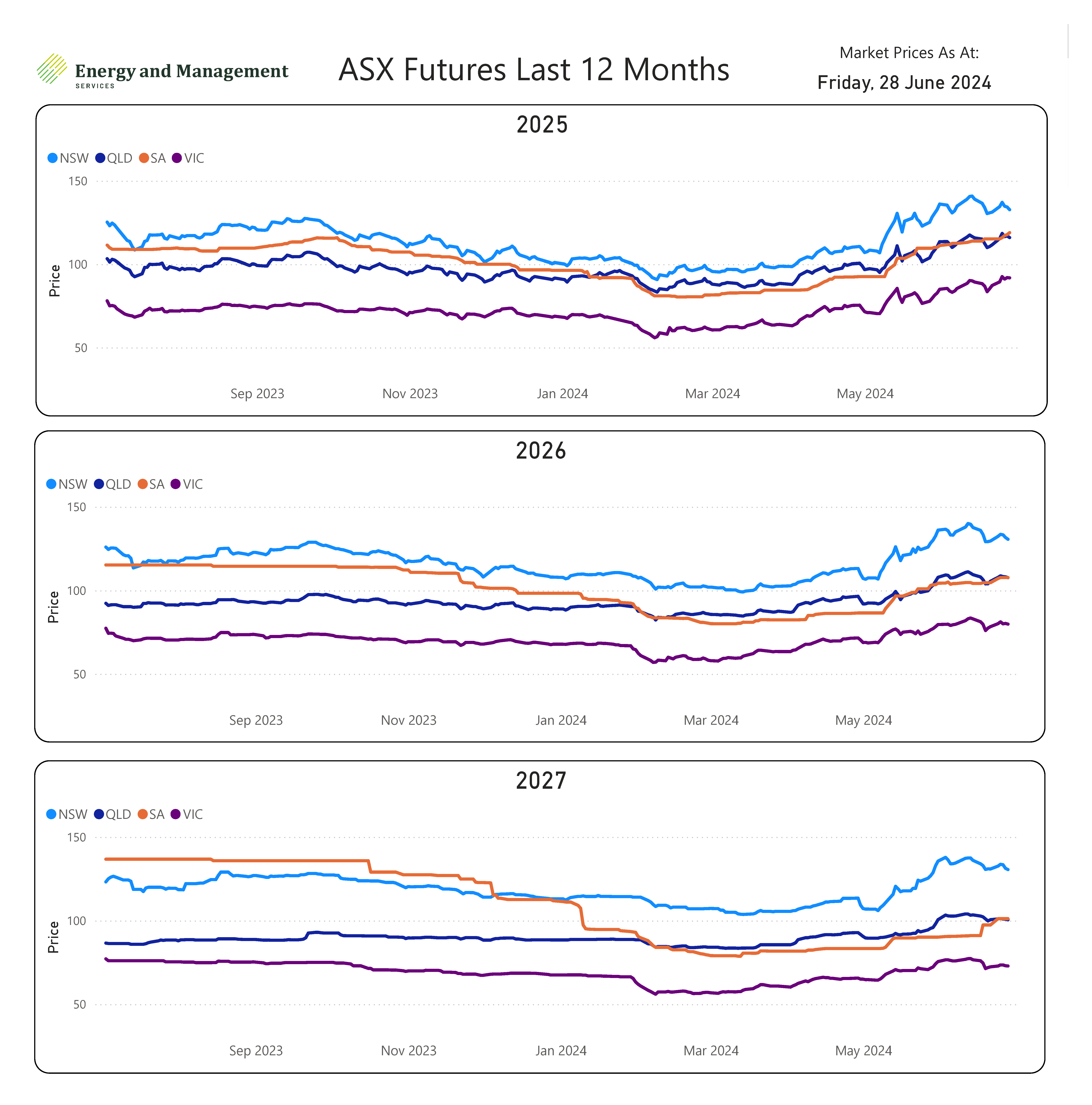
A delay in the closure of Eraring Power Station was announced later in the month, temporarily alleviating some supply concerns. However, ongoing low wind yields continued to impact the market until the end of the month when wind generation unexpectedly hit a new record high across the NEM. Eraring Units 2 and 3 returned online, providing some relief, but overall supply issues persisted. Futures prices for FY25 skyrocketed , despite a slight decline following the announcement that Eraring would continue operating.
As winter set in, the NEM experienced heightened demand and volatility. Throughout June, market demand frequently surged above 30,000 MW during peak times, driven by colder temperatures. Notably, demand peaked at over 32,000 MW on one of the coldest mornings on record. Evening demand was met with negligible solar due to the sun already setting, alongside low wind generation, which remained below average for the entire month. These factors led to frequent tight supply-demand balances in the NEM.
Exacerbating the strain on the supply network, were the multiple coal-fired power plant outages. Yallourn Unit 3 was offline for the entire month, while Eraring Unit’s 1 and 4, as well as Tarong North Unit 1, experienced extended outages. Additionally, Mt Piper Unit 1, Kogan Creek Unit 1, and Tarong Unit 3 each had brief outages. South Australia and Tasmania experienced spot price volatility earlier in June, with prices spiking due to increased demand and potentially constraints on generation. NSW experienced solar constraints in which there was a brief period of zero output, i.e. 0 MW.
AEMO issued a warning about a potential gas shortage across New South Wales, Victoria, and South Australia, potentially lasting through to September due to high gas usage for power generation. The increased volume of gas-fired generation was necessary to fill the generation gap left by low wind and solar output from the cold weather. Gas plant outages and constraints, combined with peak demand from the colder temperatures and low-depleted inventory levels, have added considerable stress to the system. Towards the end of June, forecast gas price spikes materialised, with prices reaching over $28 GJ, which subsequently elevated prices in the following days.
Futures prices for FY25 reacted accordingly to the above news and spiked, bringing the overall pricing to the baseline level which was seen in the 2022 Energy Crisis – albeit still some way before pricing reached the peak that was seen during that time. As June closed out, the prices slowly started to decline with NSW and QLD sitting at $130/MWh and $112/MWh, while VIC and SA being $84/MWh and $117/MWh.
Recent Highlights
- Federal Coalition announced plans for seven nuclear power plant sites across five states, targeting operational status by 2035-2037. ABC
- Australian Energy Week 2024 brought discussions around generation, energy storage, grid and retail elements, as well as implemented policies.
Market Reports