July to September 2026 – Review of Market Events
By Aaron Bool
July saw the introduction of a number of key changes with:
- The Market Price Cap increasing from $20,300/MWh to $23,200/MWh, alongside a higher Cumulative Price Threshold;
- Basslink became a regulated interconnector, changing its dispatch and settlement arrangements; and
- The Solar Sharer Offer commenced for eligible households in NSW, South Australia and south-east Queensland, offering a capped allowance of free electricity during a three-hour daytime window.
During the first part of July there was generally strong renewable output and contained daily spot prices, however investor concerns centred on transmission delays, planning approvals and grid-connection constraints. A Clean Energy Investor Group survey highlighted weak confidence in the pace of the renewable rollout, while ZEN Energy’s voluntary administration brought Retailer resilience into focus. Towards the middle of the month, low renewable availability coincided with coal-supply limitations at Loy Yang and restricted interstate transfers, causing sharp price spikes across the southern regions. Tasmania subsequently reached the new price cap when substantial upward repricing coincided with constrained imports. These events demonstrated how regional shortages can emerge despite generally favourable average supply conditions.
Through August, strong wind generation across the southern regions continued to support generally low daily spot prices, while futures were largely range-bound. Around the middle of the month, Yallourn’s retirement outlook reinforced the need to replace around 1.5 GW of coal generation in Victoria by mid-2028. Maintaining reliability will depend on replacement generation, storage and transmission being delivered in time. Later in the month, Tarong Unit 3 entered a planned overhaul, temporarily reducing Queensland’s available thermal capacity and highlighting the importance of managing generator availability through maintenance periods.
Towards the end of August, AEMO’s Electricity Statement of Opportunities presented an improved reliability outlook, with no forecast reliability gaps before 2030, provided projects progressed as assumed. Timely investment nevertheless remained essential as older generators retired and electricity demand increased. Data centres were a significant part of that growth: under the Step Change scenario, their share of NEM operational electricity consumption was projected to rise from around 3% to 13% by FY2035–36. The outlook highlighted the need to coordinate large new loads with additional generation, storage and network capacity.
Early September brought an extended outage at Tasmania’s Tungatinah Power Station following a major fire, with the repair timetable still uncertain. Across the broader market, strong solar output and periods of good wind generation continued to support contained daily spot prices. In the second half of the month, renewables supplied more than 80% of NEM demand during a midday interval, with rooftop solar contributing approximately half of total NEM demand. A new low in grid-supplied demand followed. These short-interval records demonstrated rooftop solar’s growing influence on daytime conditions and the increasing importance of storage and curtailment in managing surplus generation.
Towards the end of September, Victoria announced tighter requirements for new data centres, including additional renewable supply and storage to match new demand, responsibility for connection and network-upgrade costs, and exclusion from residential zones. The announcement placed greater responsibility on large new loads to support the infrastructure they require. By month-end, the Waratah Super Battery had reached final commercial operations. The 850 MW facility forms part of a system-integrity protection scheme designed to respond rapidly to network disturbances and support transmission flows, strengthening NSW’s ability to accommodate changing generation patterns.
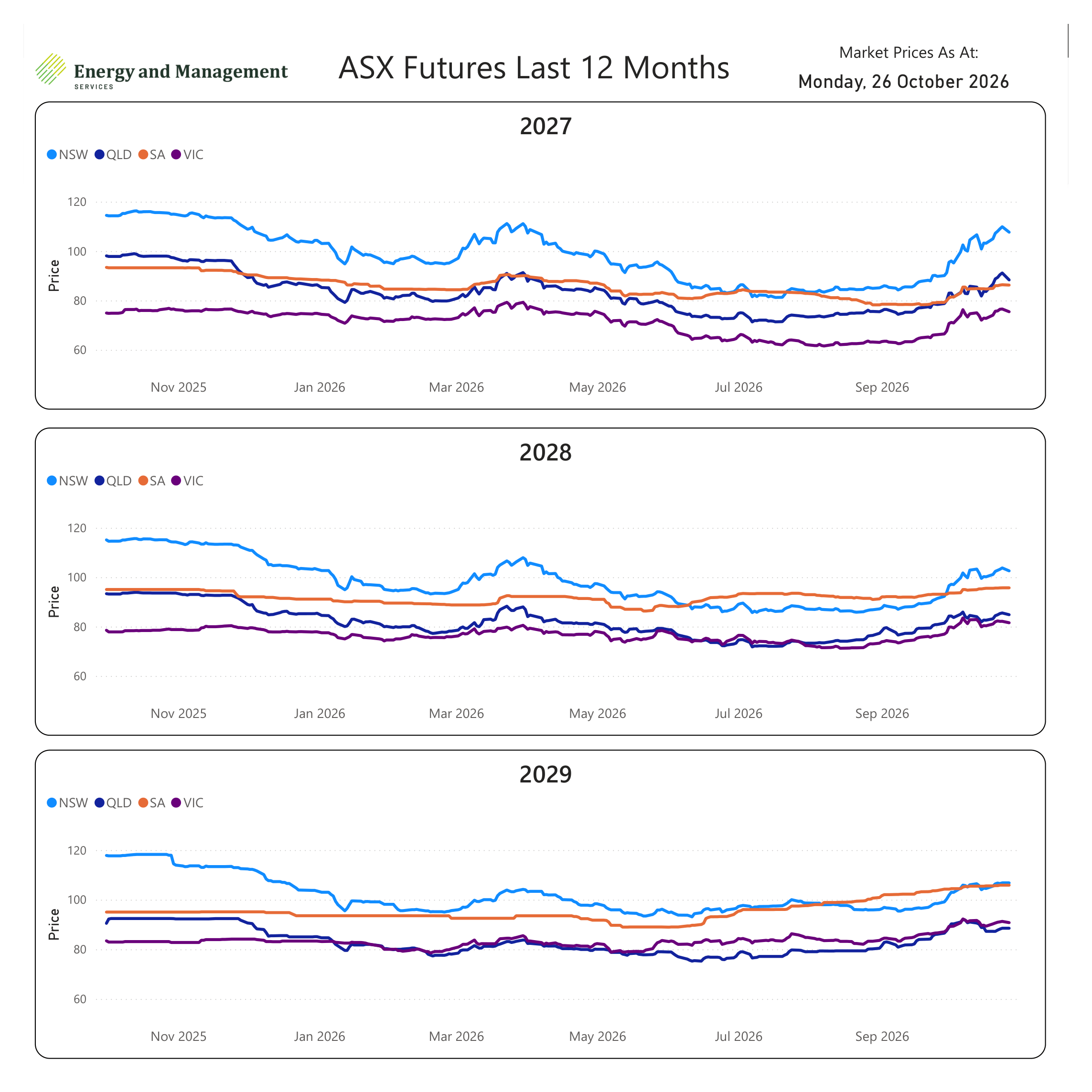
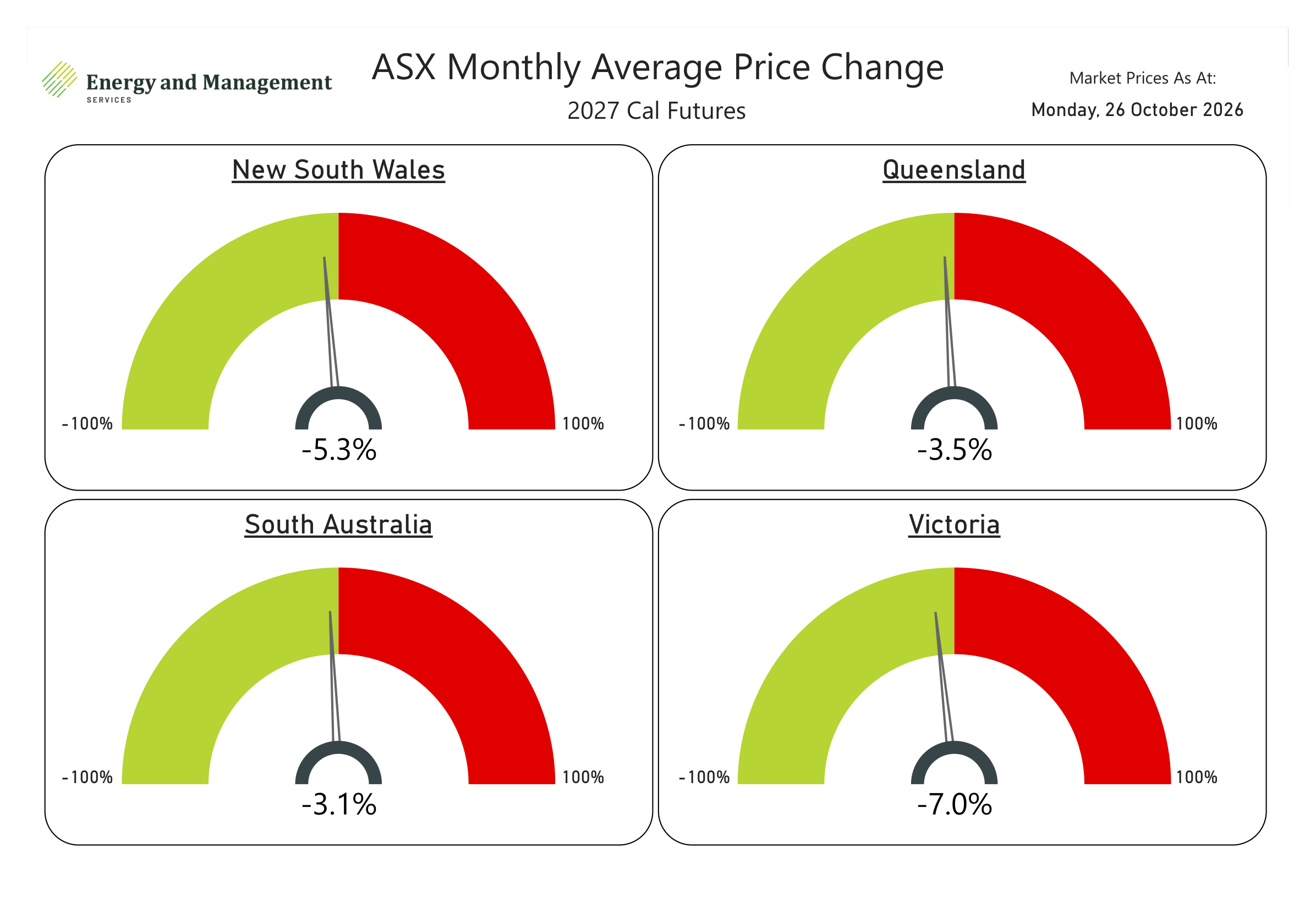
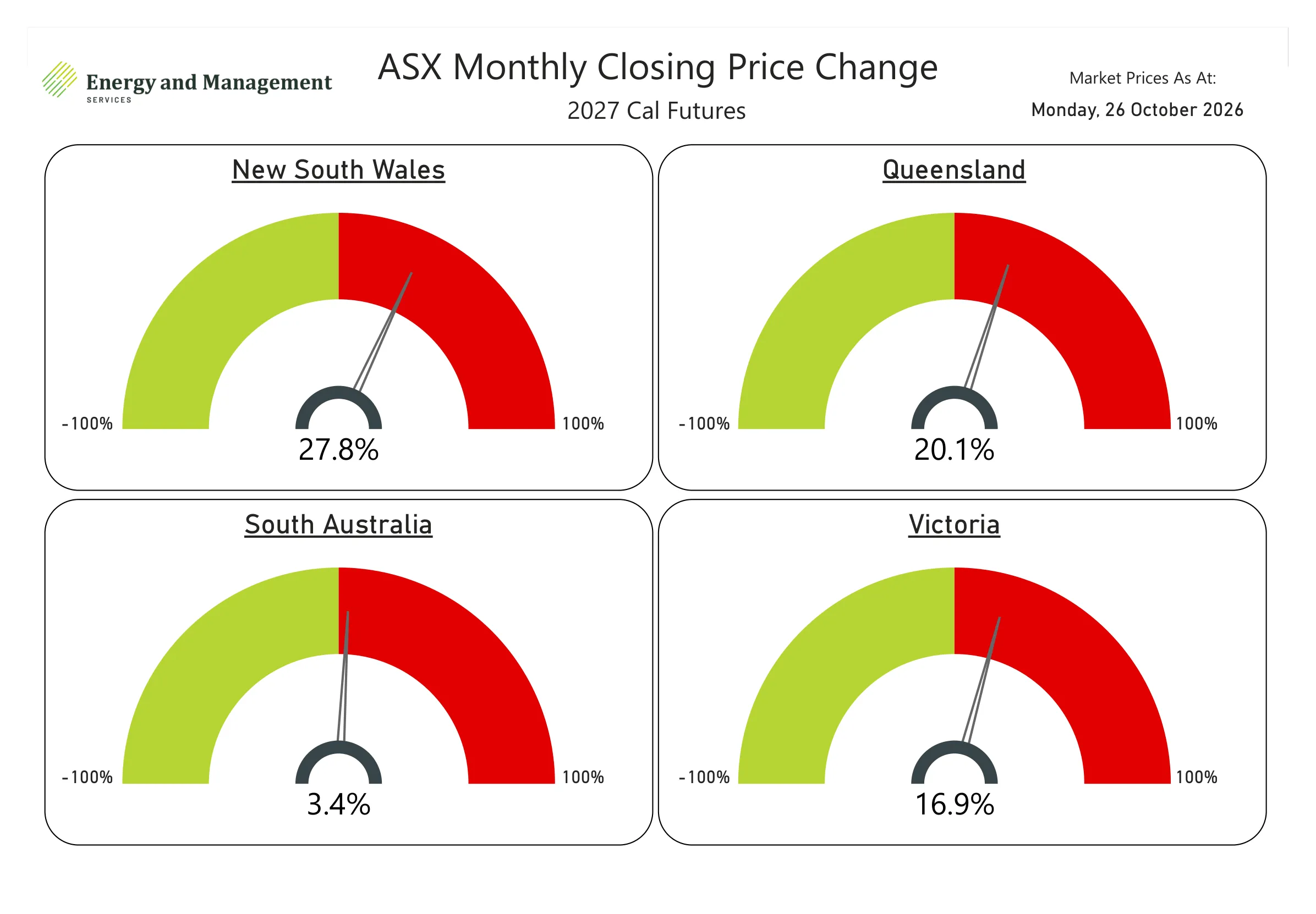
By the end of the reporting period, CAL27 futures had strengthened in NSW, Victoria and Queensland. NSW increased from $85.63/MWh to $95.48/MWh, a rise of 11.5%, while Victoria rose 7.9%, from $65.52/MWh to $70.68/MWh. Queensland increased from $74.77/MWh to $83.00/MWh, up 11.0%. South Australia moved in the opposite direction, declining 3.5%, from $84.05/MWh to $81.09/MWh. Although much of the period had seen relatively subdued trading conditions, the stronger finish showed that low daily spot prices did not necessarily translate into lower forward contract costs.
Looking ahead, rising summer demand will place greater importance on generator availability and sufficient supply. Strong renewable output, available generation, storage and interstate transfers can help contain prices. However, prolonged hot periods coinciding with low wind output, unplanned outages or transmission constraints will tighten supply margins and increase the risk of price spikes, particularly as solar output declines into the evening. Forecasts of a strong El Niño add to summer weather risks, although local impacts remain uncertain. Reliable supply during periods of peak demand will therefore be central to limiting upward price pressure.
Market Reports